

Supporting Your Child
At Atlantic Academy, we recognise that every child and young person is different. Some pupils may experience difficulties with learning, communication, emotional wellbeing or participation in school at different points in their education.
We believe that identifying needs early, listening to families and working together are essential to providing effective support.
Whether your child needs an adjustment to everyday classroom practice or more individualised provision, our aim is to help them feel confident, included and successful.
I’m Concerned About My Child. What Should I Do?
If you have concerns about your child’s learning, development, communication, wellbeing or experience of school, we encourage you to get in touch.
You do not need to wait for a formal diagnosis or assessment before discussing your concerns with us.
Your child’s class teacher or tutor is a helpful starting point. They can discuss how your child is getting on, share observations and consider whether any additional strategies or support may be helpful.
Where further support is needed, staff can involve our Inclusion Team to help identify barriers to learning and consider appropriate provision.
We value the knowledge that parents and carers bring. Sharing what works well at home, any difficulties your child experiences and their own views can help us develop a fuller understanding of their needs.
Meet Our Inclusion Team
Our Inclusion Team works alongside teachers, pastoral staff, pupils and families to identify additional needs, coordinate support and help every child thrive.
The team helps to ensure that support is appropriate, consistent and responsive as pupils’ needs develop.
|
|

Miss Ramsey (Primary SENDCo) |

Mrs Delage-Townsend (Secondary SENDCo) |

Mr Andrew Clark (Assistant Principal, Inclusion) |
How Do We Identify Additional Needs?
We recognise that pupils’ strengths, needs and circumstances can change over time.
Teachers, pastoral staff and the Inclusion Team work together to identify potential barriers to learning and participation.
This may involve:
- Reviewing progress, attainment and classroom assessments.
- Observing how a pupil learns, communicates and participates.
- Using screening or other assessment tools where appropriate.
- Listening to the pupil’s experiences and views.
- Discussing concerns and observations with parents and carers.
- Considering information or recommendations from other professionals.
Identifying a difficulty does not automatically mean that a pupil has special educational needs or requires specialist intervention.
Our priority is to understand the barriers they are experiencing and identify the most appropriate support.
Our Graduated Approach: Assess, Plan, Do, Review
When a pupil requires additional support, we use a graduated approach known as Assess, Plan, Do, Review.
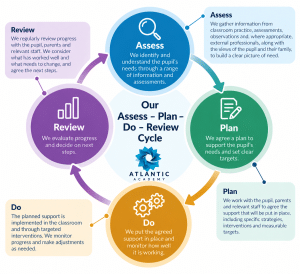
This is an ongoing process that helps us understand individual needs, put appropriate strategies in place and evaluate their impact.
1. Assess — Understanding the Need
We gather information about the pupil’s strengths, difficulties and experiences.
This may include teacher assessments, observations, screening tools and discussions with the pupil and their family.
Our aim is to develop a clear understanding of what may be preventing the pupil from making progress or participating fully in school life.
2. Plan — Agreeing the Support
We identify the strategies, adjustments or interventions that may help.
We consider what we want the support to achieve, who will be involved and when progress will be reviewed.
The views of the pupil and their family help inform this planning.
3. Do — Putting Support into Practice
Staff implement the agreed strategies and interventions.
High-quality classroom teaching remains central to the pupil’s education, with additional support provided where appropriate.
Teachers, support staff and the Inclusion Team work together to promote a consistent approach.
4. Review — Evaluating the Impact
We consider how well the support is working.
This includes reviewing progress, listening to the pupil and their family, and evaluating whether the intended outcomes are being achieved.
Support may then continue, change, increase or reduce depending on the pupil’s needs.
Assess, Plan, Do, Review is a continuing cycle, not a one-off process. As pupils develop and their circumstances change, we adapt our approach accordingly.
Individual Learning Plans
Where a pupil has identified additional needs or barriers to learning, we may create an individual Learning Plan.
A Learning Plan helps teachers and other relevant staff understand:
- The pupil’s strengths and areas of difficulty.
- The strategies and adjustments that help them learn successfully.
- Any additional support or interventions that may be required.
- The approaches that promote confidence, independence and participation.
For many pupils, a Learning Plan will primarily identify strategies from our Universal Offer, such as clear instructions, additional processing time, visual resources or adapted classroom activities.
Other pupils may benefit from additional Targeted or Targeted Plus support.
Learning Plans are shared with relevant staff to promote consistency across the academy. They are reviewed and updated as needs develop, taking account of the views of pupils, families and staff.
Having a Learning Plan does not automatically mean that a pupil requires specialist intervention or support outside the classroom.
Working with External Professionals
Sometimes, additional specialist advice can help us better understand a pupil’s needs and identify appropriate support.
Where necessary, we may work with or seek advice from professionals such as:
- Educational Psychologists.
- Specialist teachers.
- Speech and Language Therapists.
- Occupational Therapists.
- Other relevant health, education or support services.
Specialist involvement is considered according to individual needs. Access to external services may depend on referral criteria and availability.
Where professional advice is received, we consider how recommendations can inform the support provided in school.
Explore Dorset Council’s SEND Local Offer
If you would like advice and support on SEND from an impartial service, please get in touch with Dorset Sendias (SEN and Disability Information, Advice and Support Service).
Education, Health and Care Plans (EHCPs)
Some children and young people with more significant or complex special educational needs may require an Education, Health and Care needs assessment.
An Education, Health and Care Plan (EHCP) is a statutory document that identifies a child or young person’s needs, intended outcomes and the special educational provision required to support them.
An EHCP is not required for a pupil to receive additional support through our Targeted or Targeted Plus Offers.
Where a pupil has an EHCP, we work with families and relevant professionals to deliver and review the provision specified in their plan.
If you would like to discuss whether an Education, Health and Care needs assessment may be appropriate for your child, please contact our Inclusion Team.
Working in Partnership
We recognise that parents and carers know their children well and have an important role in understanding their strengths, experiences and needs.
We aim to work openly and constructively with families, sharing information, listening to concerns and involving them in decisions about support.
We also believe that children and young people should have opportunities to express their own views and contribute to decisions about their education wherever appropriate.
By working together, we can help pupils develop the confidence, independence and skills they need to thrive.
Further Information
You can explore our wider inclusion provision through the following pages:
SEND & Additional Needs — An overview of our three levels of support.
Our Universal Offer — Inclusive teaching and everyday adjustments for all pupils.
Our Targeted Offer — Additional planned support for identified needs.
Our Targeted Plus Offer — Highly personalised and coordinated support.
SEND Information & Accessibility — Our SEND Information Report, accessibility information and relevant policies.
Every child is different. Every voice matters. Every pupil deserves the right support.